Contents
- Samsung Galaxy vs iPhone: Price and Value
- Display and Design: A Tale of Two Philosophies
- Camera Performance: Samsung’s Zoom Advantage Is Real
- Battery Life: The Numbers Tell a Story
- Software and Customization: iOS vs Android
- AI: Who’s Ahead?
- Foldables: Samsung Owns This Category
- Durability and Build
- The Real Decision Framework
Samsung Galaxy vs iPhone—this choice has defined mobile phones for over a decade, and 2026 isn’t any different. I’ve spent enough time bouncing between both ecosystems to know that picking one isn’t about finding the “better” phone. It’s about finding the one that fits how you actually live.
This year, the real contenders are the Samsung Galaxy S25 and S26 series against Apple’s iPhone 16 and 17 lineups. Both hit the same $799 entry point, yet they take completely different roads to get there. Let me break down what actually matters in 2026.
Samsung Galaxy vs iPhone: Price and Value
Here’s where it gets interesting. The Galaxy S25 debuted at $799 for the base model with 128GB of storage, keeping the same price as its predecessor. The iPhone 16 has been available since September 2024, also costing $799 for its 128GB base model.
But specs-per-dollar? They’re not equal. The Galaxy S25 starts with 12GB RAM as standard instead of 8GB, while the iPhone 16 has the A18 processor with 8GB of RAM now standard across the entire lineup. At the same $799 price point, the Galaxy S25 proves to be the superior phone for the money due to its better specs, longer battery life, brighter screen, and outstanding software.
Samsung Galaxy phones start considerably cheaper than iPhones, with the A-series being a better budget buy, so if you’re tight on cash, the budget gap widens even further.
Display and Design: A Tale of Two Philosophies
The S25 has the same 6.2-inch Full-HD+ Dynamic AMOLED 2X panel as the S24, while the iPhone 16 has a 6.1-inch Super Retina XDR OLED screen, which is capped at 60Hz. Here’s what that means in real use: the Galaxy’s 120Hz adaptive refresh makes scrolling butter-smooth, but iPhone’s static display is rock-solid and uses less power.
The Galaxy is the lighter and slimmer of the two, weighing just 162 grams and 7.2mm in width, compared to the 170 grams and 7.8mm thickness of the iPhone. If you’re holding either phone for hours, that gram difference adds up, even if you don’t consciously notice it.
Camera Performance: Samsung’s Zoom Advantage Is Real
I’ve tested both extensively, and here’s where both brands excel in different areas—the comparison doesn’t have a single right answer. For long-range zoom, the Galaxy S26 Ultra has longer optical reach and high-resolution crop room, while iPhone leads in video and vlogging with steadier footage and a wider editing ecosystem.
iPhone’s processing produces more consistent, accurate-to-life results across varied lighting conditions, and iPhone’s video quality (particularly ProRes) is the best available on any mobile device—used by professional videographers. But Samsung’s zoom? For a photography hobbyist who loves zoom, the Galaxy S26 Ultra offers the longest reach and richest editing tools.
[EDITOR: agregar aquí tu experiencia personal con esto] Have you shot zoomed photos on both? Did one edge out the other in a specific scenario you actually use? Share a real moment where the camera made a difference in your choice.
Battery Life: The Numbers Tell a Story
📢 Important notice
Winspremiatop is an independent informational portal with no affiliation, authorization, or official representation from Apple Inc. or Samsung Electronics. This article compares publicly available specifications and features as of October 2026; we do not represent either brand’s interests. Our goal is to provide verified information while clearly distinguishing between official announcements, technical comparisons, and community insights. Always verify current pricing and availability with official retailers.
The average battery life for the iPhone 17 is 8-10 hours of moderate to high use, whereas the Samsung Galaxy S26 offers more like 12-15 hours of use. That’s a real gap when you’re traveling or deep in a workday. You get a 4,000mAh capacity on the S25 and a 3,561mAh cell on the iPhone 16—larger doesn’t always guarantee better runtime, but it helps here.
Charging speed favors Samsung slightly: Samsung’s 45W charging (on some models) is faster than iPhone’s 27W if you need a quick top-up.
Software and Customization: iOS vs Android
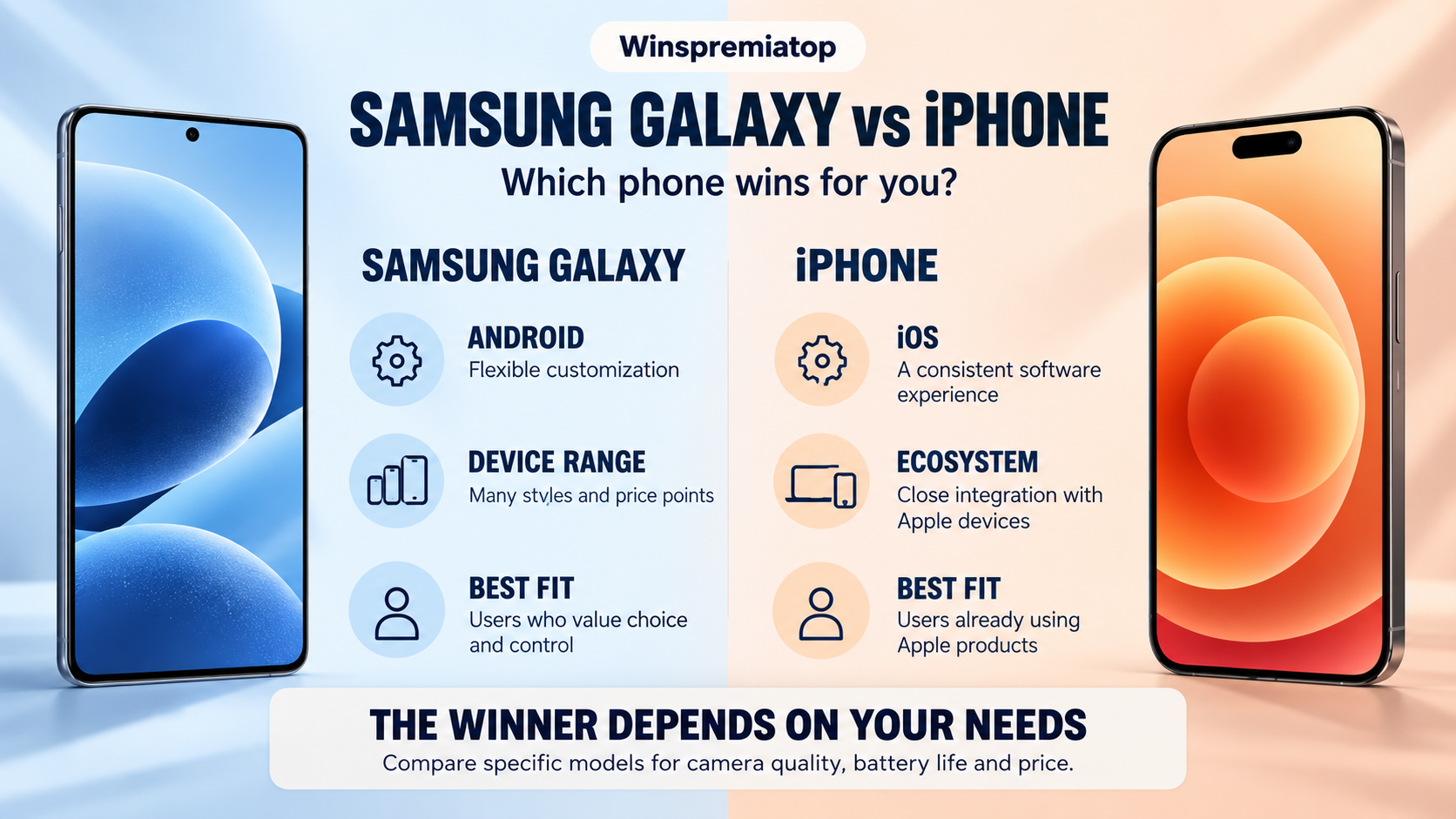
iPhone offers superior ecosystem integration, smooth user experience, and longer software support, while Samsung offers better value, more customization options, and Android freedom. If you own an Apple Watch, iPad, or Mac, iOS is the obvious path. But if you like tweaking your phone’s behavior—changing default apps, widgets, launchers—Samsung is the playground.
Winspremiatop tracks these features closely because they define daily life. On Winspremiatop, we see that power users lean Samsung, while ecosystem loyalists stay Apple. There’s no wrong answer, just different workflows.
AI: Who’s Ahead?
Samsung’s AI features are more visible and immediately impressive, with Galaxy AI’s Circle to Search as the standout feature. Apple’s approach is quieter—AI integration that works behind the scenes. For someone in Latin America using Android primarily through Google services, Samsung provides better integration than iPhone.
Foldables: Samsung Owns This Category
Samsung has foldables like the Galaxy Z Fold and Z Flip, while iPhone only recently entered the foldable space—and Samsung has a much longer track record. If you’ve been curious about a folding phone, Samsung’s mature lineup is worth exploring.
Durability and Build
iPhone’s Ceramic Shield front glass consistently performs better in drop tests, while Samsung’s Gorilla Armor 2 provides anti-reflective properties that iPhone’s display lacks. Both phones are tough, but they fail in different ways.
The Real Decision Framework
After all this, here’s how I break it down for friends asking me the same question:
You already use a Mac, iPad or Apple Watch? Go for iPhone. You shoot a lot of video? Go for iPhone. You like to customise your phone? Go for Samsung.
Add to that: For most people already in the Android/Google ecosystem, Samsung Galaxy S25 is the best Android phone available with 7-year update support—and it’s the choice for people who want more control over their device.
Frequently Asked Questions
Is Samsung Galaxy vs iPhone really that different in 2026?
Yes—they’re fundamentally different ecosystems. iPhone is closed and optimized; Samsung is open and flexible. Your existing devices (Mac, Apple Watch, or Google services) should guide your choice more than raw specs.
Which phone has better battery life?
Samsung Galaxy consistently outlasts iPhone. The S25 and S26 hit 12-15 hours of moderate to high use, while iPhones typically manage 8-10 hours. Galaxy’s larger 4000mAh battery vs iPhone’s 3561mAh makes the difference real.
Does iPhone have better cameras than Samsung?
It depends on what you shoot. iPhone excels at video (ProRes) and consistency across lighting. Samsung wins on zoom capability and raw megapixel count. For casual photos, they’re nearly identical; for zoom and video, they each have edges.
Should I buy Samsung Galaxy or iPhone if I’m on a budget?
Samsung offers far more choice below $400 with its A-series lineup. If you need a smartphone that works well at $200, Samsung has you covered. iPhone’s budget options are limited and older. For value at $799, both are solid, but Samsung gives you 12GB RAM vs iPhone’s 8GB.
Conclusion
Samsung Galaxy vs iPhone doesn’t have a universal winner in 2026—it depends on your life, not the spec sheet. Choose iPhone if you’re in the Apple ecosystem or prioritize video and simplicity. Choose Samsung if you want flexibility, better battery life, zoom capability, and customization. Both are fantastic phones; you’re just deciding which ecosystem owns more of your digital world. What’s pushing you toward one or the other? Share your thinking in the comments below—Winspremiatop loves hearing what actually matters to real users.