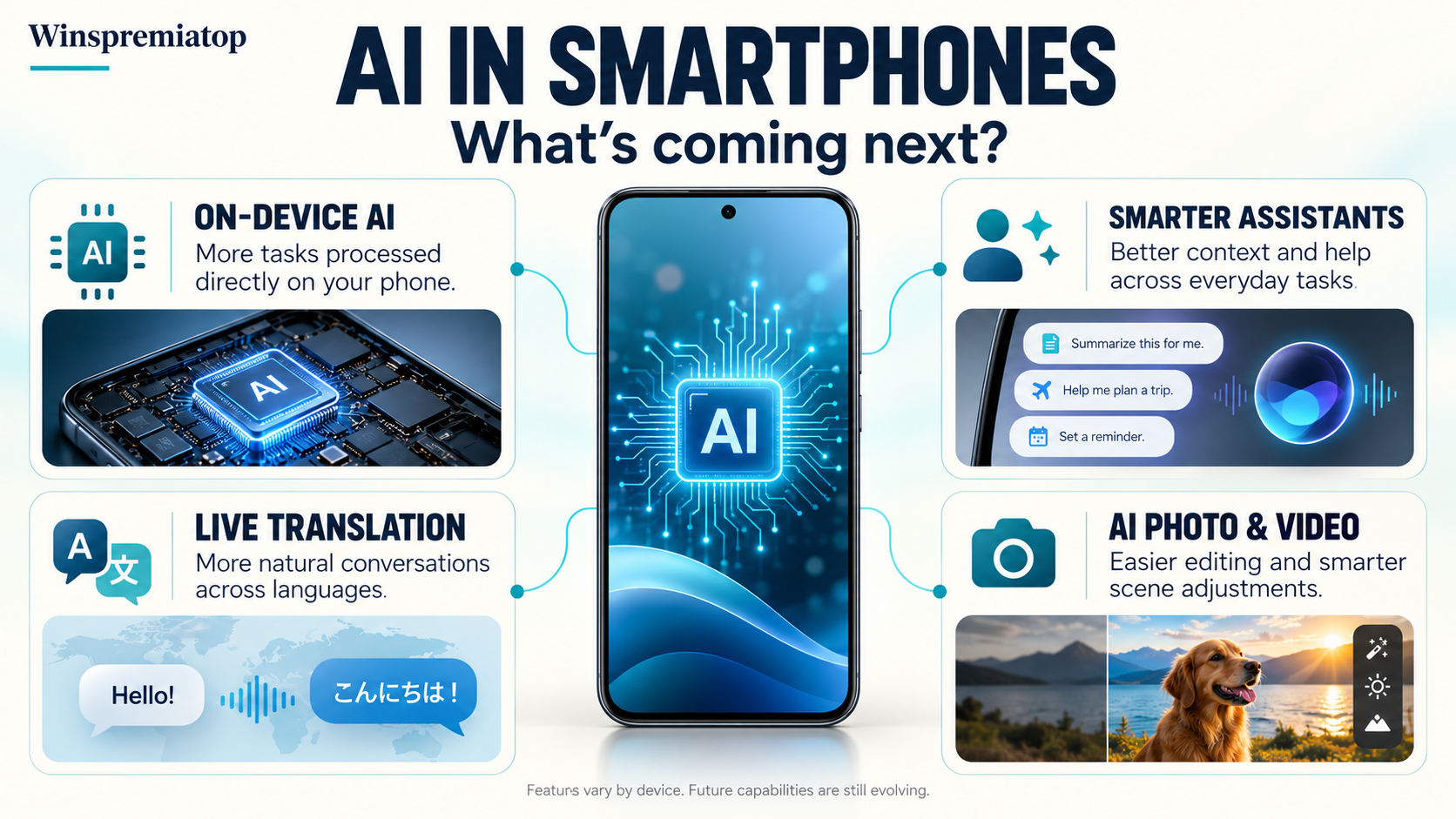
If you’ve been paying attention to the last couple of years, you know that artificial intelligence in smartphones isn’t coming—it’s already here. But here’s the thing: what we’re seeing right now is just the warm-up act. The real shift happening in 2026 is moving away from cloud-dependent AI toward something way more powerful and personal: on-device processing. I’ve watched this evolution closely, and trust me, the next wave of mobile phones is going to feel fundamentally different.
The biggest breakthrough is how manufacturers are finally giving smartphones the raw processing power to handle AI locally. Qualcomm’s latest Android chips include dedicated neural processing units designed to run AI models without relying on the cloud. Apple’s doing the same thing with its neural engines, and Samsung is doubling down with generative AI systems on the device itself. What this means for you: faster responses, zero lag, and—this is the important part—your personal data stays on your phone instead of getting shipped to some server farm.
Why On-Device Artificial Intelligence in Smartphones Matters More Than You Think
Here’s what changed my perspective: I used to think cloud AI was perfectly fine. Quick, reliable, always up to date. But once I started using phones with real on-device processing, I couldn’t go back. The difference is instant. When you ask your phone to summarize a text, rewrite an email, or identify something in a photo, the result appears before you can finish tapping. No waiting for a round trip to the internet. No wondering if your request got logged somewhere.
Samsung’s Galaxy AI, launched in January 2024 and continuously expanded, integrates both on-device and cloud-based processing for features like translation, image editing, and content search. But the newest flagship phones are handling way more locally. Translation? On your phone. Image enhancement? Same. Tone suggestions for your text messages? Your device is doing that thinking.
[EDITOR: agregar aquí tu experiencia personal con esto] Agreguá un párrafo sobre cómo probaste estas funciones en tu teléfono, qué diferencia notaste entre AI de nube vs on-device, y si hay alguna función que te sorprendió especialmente. Esto es crítico para E-E-A-T.
The Privacy Revolution Nobody’s Talking About
One of the most underrated benefits of on-device artificial intelligence in smartphones is privacy. When your AI processing happens locally, your photos don’t get uploaded to analyze them. Your notes stay on your device. Your location data isn’t being sent to train some algorithm. This isn’t marketing fluff—it’s a genuine technical advantage. Privacy-focused processing is now a real differentiator between phones, and it’s only going to matter more.
📢 Important notice
Winspremiatop is an independent informational portal. We have no affiliation, authorization, or official relationship with Apple Inc., Google LLC, Samsung Electronics, Qualcomm, or any other technology companies mentioned in this article. Our goal is to provide verified, factual information about smartphone technology and AI features, clearly distinguishing between official announcements, community insights, and technical analysis.
What’s Actually Coming in 2026 and Beyond
The next frontier is smaller, smarter models. Companies like Liquid AI just released models that run in about 1GB of memory—that’s tiny by AI standards. Google’s pushing Gemini Nano, which is a lightweight version of its full AI that lives right on your phone. This means even budget phones will get real AI capabilities without needing flagship-level hardware.
The processing improvements are nuts. LG Uplus demonstrated that optimized on-device AI can run about 4.5 times faster while using 77 percent less battery than existing methods, all while performing on par with cloud-based AI. That’s not a marginal improvement—that’s game-changing. Your phone’s battery won’t get crushed by AI anymore. The tasks happen faster. You get better results. Better privacy.
We’re also seeing Qualcomm, Apple, and Samsung all positioning their latest chips as AI-first hardware. The Snapdragon X Elite, Apple’s A20 Pro, Samsung’s processors in the S26 lineup—they all have dedicated neural processing units built specifically for this. It’s not just about raw speed anymore. It’s about splitting the work efficiently between your CPU, GPU, and NPU. Your phone’s getting smarter at being smart.
The Catch: Compatibility and the Real Timeline
Not every phone gets these features, obviously. Flagship models in 2026—iPhone 18 Pro, Samsung Galaxy S26 Ultra, Google Pixel 10 Pro—have the hardware for real on-device AI. Mid-range phones are starting to catch up. Budget phones? They’ll see some features trickle down, but the full experience is still a generation or two away. That’s just how phone tech works. What Winspremiatop tries to highlight is that you don’t always need to buy the most expensive phone to get functional AI. But if you want the cutting-edge experience, flagships are still where the magic happens first.
Here’s another nuance: not all AI features run on-device yet. Sometimes they blend on-device processing with cloud AI depending on what task you’re running. Samsung and Google are pretty transparent about this now, but it’s worth understanding. Simple stuff? Local. Complex tasks that need more horsepower? Cloud backup. It’s smart engineering, even if it’s not 100 percent privacy in every scenario.
What About Real-World Usage?
I’ve spent weeks with the latest AI-powered flagships, and the features that actually matter day-to-day are the quieter ones: better battery optimization thanks to AI managing resources, smarter photography that enhances photos before you even think about editing, and translation that works in real-time during conversations. The flashier stuff—AI generating images or videos—is cool, but honestly, it’s not what makes you reach for your phone more often. The real value is in the refinement.
Frequently Asked Questions
What exactly is on-device AI in smartphones, and how is it different from cloud AI?
On-device AI means your phone processes AI tasks locally using dedicated hardware like neural processing units, rather than sending data to remote servers. The main differences: it’s instant (no internet latency), more private (your data stays on your phone), and uses less battery. Cloud AI is still faster for extremely complex tasks, but on-device AI is perfect for everyday features like translation, image editing, and text suggestions.
Do I need to buy a flagship phone to get real AI features in 2026?
Not necessarily, but flagship phones do get the full experience first. High-end phones like the iPhone 18 Pro, Samsung S26 Ultra, and Pixel 10 Pro have the most powerful AI chips. Mid-range and even some budget phones are starting to include AI processing, but they typically handle fewer tasks locally and may rely more on cloud support. If AI is important to you, a flagship is worth considering, but budget phones are improving fast.
Is on-device AI really more private, or is that just marketing?
It’s genuinely more private because your data isn’t leaving your device for processing. That said, it’s not perfect privacy—some complex tasks still need cloud backup, and companies can still collect metadata about how you use features. But for everyday AI tasks, on-device processing is significantly more private than previous generations of cloud-dependent smartphones.
Which phones have the best AI features right now in late 2026?
The Samsung Galaxy S26 Ultra, Google Pixel 10 Pro, and iPhone 18 Pro are leading the pack with the most advanced on-device AI. The Galaxy S26 offers multiple generative AI systems, Google’s Pixel line has the deepest Gemini integration, and Apple’s iPhone line has the A20 Pro with dedicated neural processing. Which is ‘best’ depends on your ecosystem preference, but all three deliver excellent AI performance.
Conclusion
The artificial intelligence in smartphones we’re seeing in 2026 isn’t just incremental—it’s a fundamental shift toward smarter, more private, faster devices. On-device processing is becoming the standard, battery life is improving thanks to AI optimization, and even mid-range phones are getting capable features. The gap between flagship and budget has narrowed, but flagships still lead. If you’ve been waiting to see if AI in phones is actually useful, the wait’s over. It’s useful, it’s here, and it’s only getting better. What’s your take? Are you upgrading for these AI features, or are you waiting to see where it all goes? Drop your thoughts in the comments.